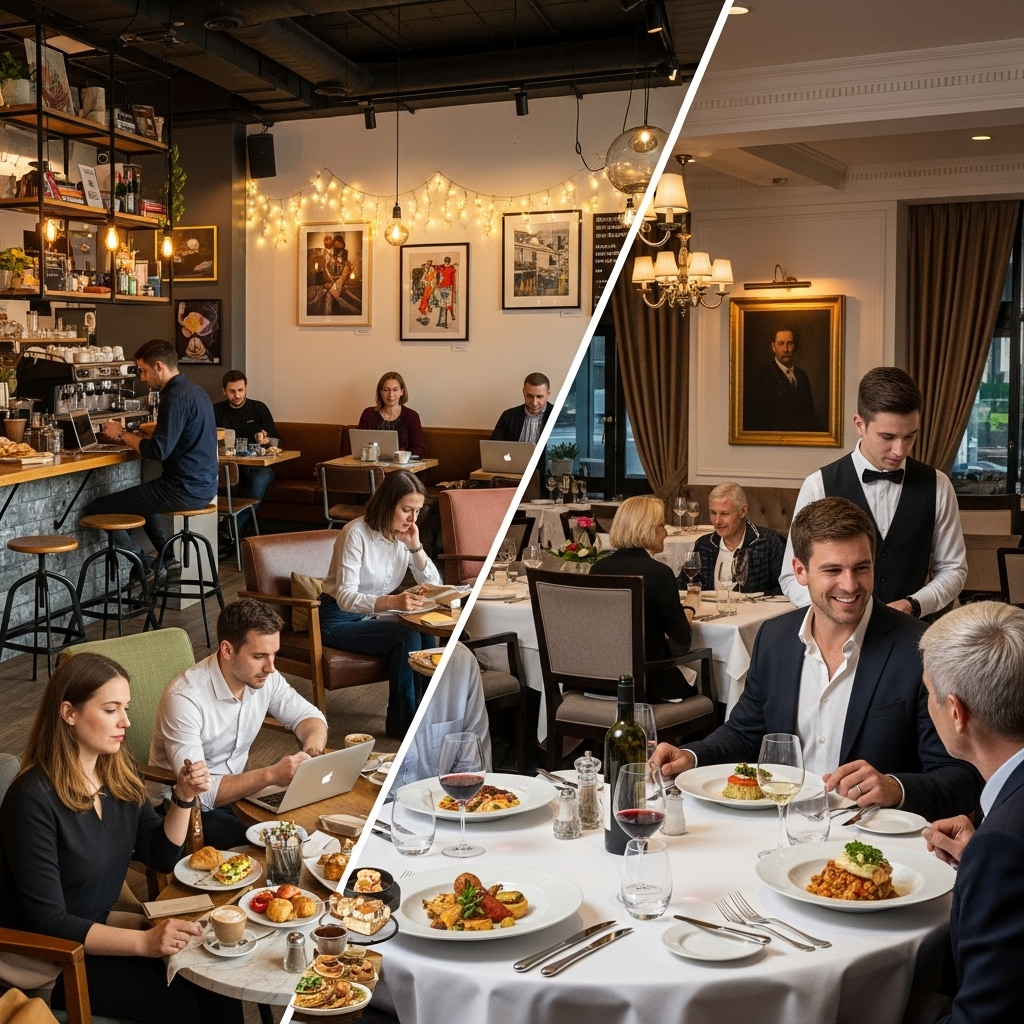
Comfort in cafe and restaurants isn’t a single characteristic you can increase or decrease, but rather a combined feeling that arises from the sounds within the space, the visible and tactile materials, how people sit and move, how service is provided, and even the psychology of how guests interact with the place. Research indicates that although both types of establishments rely on similar basic components, cafes and restaurants tend to prioritize these components differently. Cafes are highly sensitive to acoustic comfort and intimate spatial cues, while restaurants place more emphasis on the choreography of service quality, layout, and operational execution. Simply put, comfort has many facets, and its recipe changes with context.
Acoustic comfort and the “right to be heard”
The main driver of cafe comfort is the ease of conversation with background music. When the music swells beyond a moderate level, people raise their voices, consonants blur, and the flow of conversation is disrupted. When the level is supportive, guests report greater ease and satisfaction. Field and laboratory research on conversational ease in cafe environments consistently highlights music volume as a lever that can facilitate or hinder social interaction, with higher volumes decreasing perceived acoustic comfort and the perceived ability to connect with friends (Maruyama et al., 2020). The practical conclusion is not “without music” but “adjust the music to the task.” Cafes designed for studying or intimate conversations should keep the level low and the spectral content unobtrusive; in busier social cafes, set the level a little higher but maintain speech clarity.
Acoustic comfort is also related to seating patterns. Grouped small tables, soft finishes, and sound-absorbing surfaces reduce reverberation and dampen spreading chatter, encouraging guests to “compete” for audibility (Maruyama et al., 2020). This design decision is important because cafe guests often come with the intention of chatting or working, thus prioritizing the signal-to-noise ratio in the literal sense.
Materials and the warmth of the place
The “ambiance” of a cafe is not just what people hear, but also what they see and touch. Research specifically focused on cafes shows that wall materials measurably shape perceptions, with lighter-colored wood tending to be perceived as warmer, more inviting, and more consistent with ideal cafe atmosphere mental models (Coşgun et al., 2021). This surface choice also interacts with light, featuring matte wood with visible grain that reduces glare and adds visual texture, often interpreted by people as comfortable and human-scale (Coşgun et al., 2021). Therefore, designers can adjust comfort by using lighter-colored wood on large wall surfaces and reserving darker colors for accent areas that prioritize intimacy over brightness.
Cafes also borrow psychological legitimacy from their status as a “third place,” meaning an environment outside of home and work that supports relaxation, light social interaction, and a sense of belonging. When a cafe succeeds in this dimension, guests report similar increases in psychological well-being to those seen in other restorative urban environments (Lee, 2022). This “restorative” experience complements the material and acoustic layers: the warm wood and soft acoustics create a canvas upon which the third-place experience is painted (Coşgun et al., 2021; Maruyama et al., 2020; Lee, 2022).
When comfort means choreography: restaurants and operational excellence
Restaurants certainly benefit from well-tuned acoustics and carefully designed materials, but diners often evaluate “comfort” from a broader operational perspective, namely smooth queues and seating, neat table spacing, clear sightlines, speed of service, and perceived staff competence. Large-scale synthesis of restaurant satisfaction drivers identified layout, decor, food quality, and service quality as core determinants of the overall experience, with service touchpoints and spatial legibility shaping comfort in ways that go beyond mere decoration (Zanetta et al., 2024). In other words, a beautiful room can still feel uncomfortable if the service is sloppy, the hallways are narrow, or the pace of the meal is off.
Complementary evidence underscores the role of infrastructure and operations as mediators of convenience. When restaurants and cafes standardize back-of-house processes, carefully maintain physical assets, and support service teams with adequate infrastructure, guests report higher satisfaction with the environment itself—indicating that reliable operations “enhance” the perception of spatial comfort (Z.A. et al., 2022). The effects are intuitive, with clear signage reducing stress in finding your way, stable temperature regulation preventing thermal discomfort, and table spacing avoiding crowding maintaining privacy. The guests did not specify these factors, but they simply found the place comfortable.
This story unfolds during a period of heightened risk perception, where dining out in the pandemic era, safety protocols and environmental services become intertwined with comfort itself, as visitors evaluate distance, sanitation speed, and staff signaling about hygiene norms (Jeong et al., 2021). The layout and choreography of the service are part of the comfort, not just compliance, but a useful principle for peak Friday dinners as much as for years constrained by public health.
The atmosphere, expectations, and the fit between people and place
Even beyond acoustics, materials, and operations, comfort depends on the suitability of the place to the guests’ purpose and personality. Research mapping the characteristics of people and their everyday places shows that individuals seek environments that are “congruent” with their current conditions and goals, such as introverted guests recharging in quieter corners, while highly extroverted guests might prefer energetic, crowded zones rather than those that drain their energy (Matz et al., 2020). The “transactions” of this place reframed practical challenges for the operator: one room had to accommodate multiple micro-environments so that different types of guests could find their comfortable corner.
Restaurants, with clearer social scripts and more limited visit durations, often target a dominant atmosphere that aligns with their cuisine and service style. Cafes, with varying wait times and diverse uses ranging from working on laptops to group gatherings, benefit from zoning strategies with cushioned seating and bookshelves for quiet work, two tables near power sources, brighter social areas along the barista line, and busy areas away from grinders and dishwashers (Maruyama et al., 2020, Coşgun et al., 2021). Therefore, person-place congruence can be designed by distributing acoustics, materials, and seating to support more than one “comfort script” simultaneously (Matz et al., 2020).
Visual storytelling: decorations that clarify, not confuse
Environmental decorations and graphics should guide guests, rather than overwhelm them. Reviews of factors determining restaurant satisfaction repeatedly show that interior decoration and identity are positive factors, especially when these elements coherently express the concept and are supported by easy-to-understand signage and sightlines (Zanetta et al., 2024). In cafes, the same principle applies, but guests are more sensitive to small-scale textures, such as wood grain, plants, and natural finishes that communicate a “human touch,” as well as accent lighting that defines personal space at tables (Coşgun et al., 2021). Avoid head-high visual clutter in the seating zone; maintain strong graphic movement for transition areas, where stimulation is shorter.
Layout and distance: comfort as distance management
The microphysics of desks and corridors influence the perception of comfort more than many teams realize. Narrow aisles increase the risk of collisions and attention load (“I have to eat every time the waiter passes”), while tables that are too close together reduce the perception of privacy. Syntheses across various restaurant studies consistently place spatial organization at the top of the list of determinants, both directly (guests notice the distance) and indirectly (the layout allows for smoother service and fewer disruptions) (Zanetta et al., 2024; Z.A. et al., 2022). In cafes, distant seating (not directly facing strangers), corner benches, and soft partitions make quiet laptop sessions and chats feel less open (Maruyama et al., 2020).
Technology, novelty, and the comfort zone
Some restaurants have experimented with robot waiters, which pique curiosity and, in certain contexts, are appealing. However, new things don’t always mean comfort. Evidence of guest reactions to robot service in restaurants suggests that perception depends on appropriateness: whether the robot “fits” the concept and promise of service, or whether it adds friction between guests and staff (Zhang et al., 2022; Huang et al., 2022). For operators, this principle echoes previous themes, namely that comfort is created when elements, both human and mechanical, feel well-integrated with the space, menu, and service rhythm.
Culture, signals, and the meaning of comfort
Cross-cultural online review mining reveals that restaurant visitors discuss “comfort” thru various proxies, sometimes the authenticity of the food and the warmth of the service, and sometimes the quiet atmosphere and visual cleanliness (Jia, 2020). This variation warns against uniform design: the same dim lighting that seems “cozy” to one group might seem “dim/confusing” to another. Practically speaking, cross-cultural spaces should prototype with local guests, implement feedback, and update less-than-optimal elements, which is an operational attitude related to better environmental evaluation (Z.A. et al., 2022; Zanetta et al., 2024).
Bringing it all together: a comfortable guide
For cafes:
Control the soundscape. Keep background music at a level that supports conversation and solo focus, and use absorbent finishes and spaced-out seating arrangements to maintain speech clarity (Maruyama et al., 2020).
Warm and bright wood on the main surfaces. Choose light-colored wood for the main wall surfaces to radiate warmth and approachability, and use darker colors for intimate corners (Coşgun et al., 2021).
Zones for various purposes. Providing quiet corners, energy-efficient dual roofs, and more lively social areas, which enhances the compatibility of people with the space among different types of guests (Matz et al., 2020; Maruyama et al., 2020).
Third place signal. Include signals of informality and belonging (community boards, open views for designing processes) that support psychological recovery (Lee, 2022).
For the restaurant:
-
Arrange the walkway. Consider the distance between tables, the width of the aisles, and the line of sight as the basis for comfort, as smooth pacing and clear flow reduce stress and improve perceived quality (Zanetta et al., 2024).
-
Operational reliability as an atmosphere. Invest in infrastructure that ensures consistent temperature, lighting, and service provision, as reliability itself is defined as environmental comfort (Z.A. et al., 2022).
-
Match the decorations to the promise. Use decorations that are coherent with the concept to clarify expectations, and avoid cluttered decorations that make wayfinding or interaction at the tables difficult (Zanetta et al., 2024).
-
Security as comfort. In high-risk contexts, making cleanliness and social distancing visible and routine, and the perception of care directly increases comfort (Jeong et al., 2021).
For both:
-
Measure what guests mean by “comfortable.” Track comments and reviews to learn which proxies (calm, warm, distance, friendly) your audience is using and adjust accordingly (Jia, 2020).
-
Integrate technology carefully. Use robots or self-service only if they can improve, not degrade, the quality of service (Zhang et al., 2022; Huang et al., 2022).
Why cafes and restaurants are different (and sometimes merge)
If cafes are very sensitive to music levels and material warmth, while restaurants live and die by spacing and service choreography, it’s because guests come with different intentions and time patterns. Cafes offer a lingering, conversational, or task-oriented experience, while restaurants provide limited and structured meals based on roles. However, they both met when the same human needs arose: audibility, readability, security, and suitability. A small neighborhood restaurant on a Tuesday can feel like a cafe, quiet, refreshing, and bathed in wood. While a busy weekend lunch cafe can behave like a restaurant, with waiters serving food, line-of-sight management, and speed rules. Essentially, for designers and operators, it’s not about choosing a single template, but rather identifying the dominant guest goals in each part of the day and designing an appropriate mix of comfort (Maruyama et al., 2020; Coşgun et al., 2021; Zanetta et al., 2024; Z.A. et al., 2022; Lee, 2022).
In essence
Everything you prepare, including conversational acoustics, material perception, operational reliability, service choreography, person-place fit, and cross-cultural sentiment, will support a simple conclusion: comfort is a system. For cafes, the system is highly dependent on acoustic comfort and a warm, human-scale atmosphere, while for restaurants, it relies on spatial clarity, speed, and signals of competence embedded in the service and infrastructure. Both succeeded when the parts aligned with the guest’s purpose, and failed when even one part (noise, distance, speed, or surface) became a point of friction.
References
-
Coşgun, Büşra, Kemal Yıldırım, and Mehmet Lutfi Hidayetoglu. “Effect of Wall Covering Materials on the Perception of Cafe Environments.” Facilities 40, no. 3/4 (November 2, 2021): 214–32. https://doi.org/10.1108/f-07-2021-0060.
-
Huang, Huiling, and Stephanie Q. Liu. “Are Consumers More Attracted to Restaurants Featuring Humanoid or Non-humanoid Service Robots?” International Journal of Hospitality Management 107 (August 8, 2022): 103310. https://doi.org/10.1016/j.ijhm.2022.103310.
-
Jeong, Miyoung, Kawon Kim, Forest Ma, and Robin DiPietro. “Key Factors Driving Customers’ Restaurant Dining Behavior During the COVID-19 Pandemic.” International Journal of Contemporary Hospitality Management 34, no. 2 (December 14, 2021): 836–58. https://doi.org/10.1108/ijchm-07-2021-0831.
-
Jia, Susan. “Motivation and Satisfaction of Chinese and U.S. Tourists in Restaurants: A Cross-cultural Text Mining of Online Reviews.” Tourism Management 78 (January 7, 2020): 104071. https://doi.org/10.1016/j.tourman.2019.104071.
-
Lee, Narae. “Third Place and Psychological Well-being: The Psychological Benefits of Eating and Drinking Places for University Students in Southern California, USA.” Cities 131 (October 26, 2022): 104049. https://doi.org/10.1016/j.cities.2022.104049.
-
Maruyama, Naoya, Yasuhiro Hiraguri, Keiji Kawai, and Mari Ueda. “Assessing the Ease of Conversation in Multi-group Conversation Spaces: Effect of Background Music Volume on Acoustic Comfort in a Café.” Building Acoustics 27, no. 2 (January 10, 2020): 137–53. https://doi.org/10.1177/1351010×19897232.
-
Matz, Sandra C., and Gabriella M. Harari. “Personality–place Transactions: Mapping the Relationships Between Big Five Personality Traits, States, and Daily Places.” Journal of Personality and Social Psychology 120, no. 5 (June 4, 2020): 1367–85. https://doi.org/10.1037/pspp0000297.
-
Z.A., Saida Zainurossalamia, Dwi Martiyanti, Gusti Noorlitaria Achmad, Dadang Lesmana, and Rizky Yudaruddin. “Impact of Operational Activities on Customer Satisfaction in Cafes and Restaurants: A Mediating Role of Infrastructural Elements.” Innovative Marketing 18, no. 4 (October 11, 2022): 13–24. https://doi.org/10.21511/im.18(4).2022.02.
-
Zanetta, Luis D’Avoglio, Marina Carvalho Xavier, Mariana Piton Hakim, Elke Stedefeldt, Laís Mariano Zanin, Caroline Opolski Medeiros, and Diogo Thimoteo Da Cunha. “How Does the Consumer Choose a Restaurant? An Overview of the Determinants of Consumer Satisfaction.” Food Research International 186 (April 19, 2024): 114369. https://doi.org/10.1016/j.foodres.2024.114369.
-
Zhang, Xiya, Balaji, and Yangyang Jiang. “Robots at Your Service: Value Facilitation and Value Co-creation in Restaurants.” International Journal of Contemporary Hospitality Management 34, no. 5 (March 17, 2022): 2004–25. https://doi.org/10.1108/ijchm-10-2021-1262.