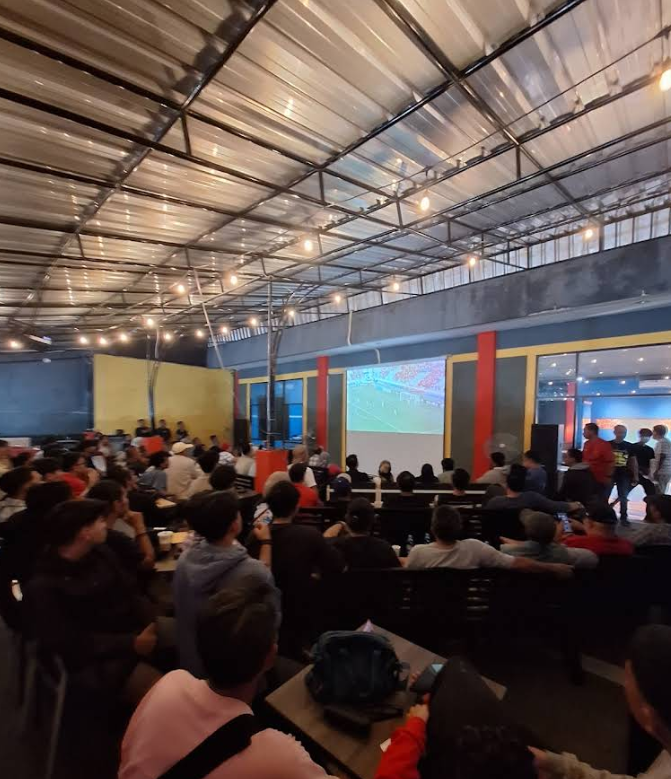
Background of Cultural Shift in Cafes: from “gathering space” to “individual space”
Many studies have shown that traditional cafes were once places where people could meet, chat, and build social connections on a daily basis, for example, while watching major sporting events together (Viartasiwi & Trihartono, 2020). Findings from Indonesia suggest that the transformation of traditional coffee shops into global-style cafes has resulted in more casual interaction patterns: spaces have become more aesthetically pleasing, “Instagrammable,” and equipped with Wi-Fi, but are increasingly less conducive to spontaneous conversations between customers v.
A similar shift has occurred in research on cafe culture in Prishtina, Kosovo. These studies show how “cafe culture” may simply be a backdrop to urban life, where people prioritize image and consumption over community dialogue, a supposed “third space” (Canolli, 2022). In the context of communal viewing, this means that modern cafes are less likely to have “community tables” and the traditional communal viewing rituals that bring people from diverse backgrounds together.
However, the demand for “togetherness” while watching remains high because it offers psychological benefits.
Research shows that watching sports together not only increases enjoyment but also offers psychological and social benefits. Experimental investigations across contexts have shown that crowd presence can synchronize physiological responses between individuals and increase feelings of belonging, thereby fostering social connection (Baranowski-Pinto et al., 2022).
Research shows a positive association between attendance at live sporting events and subjective well-being, including reduced loneliness; therefore, “shared moments” during games are socially beneficial (Keyes et al., 2023). In an elderly Japanese population, watching sports was correlated with reduced depressive symptoms, suggesting a protective socio-psychological aspect of this activity (Tsuji et al., 2021).
Recent studies in social psychology have shown that watching sports can increase feelings of empowerment through social interaction and sustained positive emotions; thus, collective excitement not only serves as a “crowd bond” but also as a catalyst for individual control and positive affect (Guo et al., 2024). This is why people are still drawn to “watching together,” even though the format has changed.
Migratory togetherness has evolved from physical locations to social TV and streaming platforms
People still crave a sense of community, even as modern cafes become more self-contained. They’re taking it to digital platforms. Social live streaming and social TV allow people to “watch together” in a virtual setting, where they can provide comments, emoticons, or emotions in real time, making it seem as if they’re all there together (Han Soo Kim & Minjung Kim, 2020).
Research shows that co-watching social TV, whether in person or through hybrid methods, increases social presence, the feeling of “the presence of others” that viewers experience while watching, making the experience feel more social even when people are not in the same room (Jihyun Kim et al., 2020). Recent research on “well-being in digital viewing behavior” suggests that online platforms, interactive features, and community standards can contribute to social satisfaction and well-being, just as in-person togetherness does (R. G. et al., 2021).
Thus, the fact that fewer people are watching together in cafes means that people are shifting their social interactions to digital channels that are easier to use, cheaper, and available in more places (Han Soo Kim & Minjung Kim, 2020; Jihyun Kim et al., 2020).
What makes modern cafes less “communal”?
Several variables, when examined through the sociological perspective of cafes, make group viewing less common in contemporary cafes:
Layout and how people use it. Modern cafes generally focus on creating quiet spaces with small tables, electrical outlets, and background music that make it easy for people to work alone or enjoy some “me time” (Viartasiwi & Trihartono, 2020).
Changing the way events are planned. Instead of communal events like watching local league sports together, event programming is sometimes replaced with brand-centric events like playlist screenings that don’t require customer participation (Canolli, 2022).
Reducing “communal tables.” Seating arrangements make it difficult for people to converse spontaneously with each other by keeping users at a distance and forcing them to focus on their own screens (laptops/phones). However, for effective group viewing, everyone needs to be looking at the large screen and coordinating their movements together (Viartasiwi & Trihartono, 2020).
This combination destroys the social ecology that used to involve group viewing and shifts the flow of “social energy” to digital platforms designed for simultaneous remote interaction (R. G. et al., 2021).
How can we maintain these significant benefits?
Despite the changing formats, the social and psychological benefits of watching sports together remain compelling reasons to maintain the practice of gathering together, whether in person or online. First , the “crowd bonding” aspect enhances a sense of belonging (Baranowski-Pinto et al., 2022). Second , there is consistent evidence that participation in athletic events, particularly as spectators, is associated with increased subjective well-being and reduced loneliness (Keyes et al., 2023). Third , for certain demographics, the act of watching can be associated with improved mental health indicators, thus serving as a socio-emotional “buffer” (Tsuji et al., 2021).
Rather than “lamenting” the decline in group spectators at cafes, it might be better to consider a hybrid model that combines physical and digital environments (Jihyun Kim et al., 2020; Han Soo Kim & Minjung Kim, 2020).
Practical advice: from cafe entrepreneurs to the people who support them
For cafe owners:
Consider creating zones and implementing shared screens. Add public spaces with large screens, directional sound, and seating configurations that make it easy for everyone to watch together. This type of setup has slowly disappeared in modern cafes (Viartasiwi & Trihartono, 2020).
“Watch parties” are on the calendar. Hosting watch parties for local leagues, national teams, and international competitions is a signature event that connects the cafe with the community (Canolli, 2022).
Blending experiences. Add social TV channels that include hashtags, chat boards, or QR groups for live comments, allowing consumers at home and on-site to feel like they are “in the same place” (Jihyun Kim et al., 2020; Han Soo Kim & Minjung Kim, 2020).
For local supporters and organizers:
Cross-spatial partnerships. Collaborate with a nearby cafe to host a series of watch parties, then leverage digital platforms like Discord, WhatsApp, and YouTube Live to keep attendees engaged even after they leave (R. G. et al., 2021).
Social health messages. Leverage research on the benefits of togetherness—such as bonding, reduced loneliness, and improved emotional well-being—for inclusive “healthy watch party” literacy initiatives (Baranowski-Pinto et al., 2022; Keyes et al., 2023).
For those who build cities and manage public spaces:
Shared spaces can serve multiple purposes. Install viewing infrastructure at the neighborhood level, such as in city parks or community centers, so commercial cafes don’t have to bear the full burden of the “third space” (Tsuji et al., 2021).
This ecosystem blends urban and rural elements. Encourage the use of city internet platforms, such as digital bulletin boards and live chat channels, to connect people before and after the game (Jihyun Kim et al., 2020).
Bridging the gap: creating “relevant togetherness”
The key to this shift isn’t whether we still watch together, but where and how we do it. Traditional cafes create a solid physical space for people to gather; contemporary cafes offer unique experiences for everyone; and digital platforms reinvent the idea of togetherness by adding interactive aspects (Viartasiwi & Trihartono, 2020; Han Soo Kim & Minjung Kim, 2020).
When cafe owners were bold enough to transform their spaces by reopening “communal tables,” reintroducing watch parties, and connecting them to social TV channels, the tradition of watch parties was preserved and enhanced: a pleasurable physical experience combined with a digital network that expanded reach (Jihyun Kim et al., 2020). The result was a flexible ecology of togetherness that consistently delivered psychological benefits, including social connection, belonging, and collective satisfaction (Baranowski-Pinto et al., 2022; Keyes et al., 2023).
Conclusion
The tradition of watching sports together in cafes has declined due to the spatial reconfiguration and consumption ethos of contemporary cafes; however, the human tendency to celebrate sporting events “en masse” remains, having evolved and shifted locations (Viartasiwi & Trihartono, 2020; Canolli, 2022). Social TV and live streaming platforms demonstrate that individuals can forge meaningful connections through digital interactions (Han Soo Kim & Minjung Kim, 2020; Jihyun Kim et al., 2020). When physical and digital spaces merge, watching together is more than just “nostalgia”; it is a new way of gathering that fits modern lifestyles while providing research-proven social and psychological benefits (Baranowski-Pinto et al., 2022; Keyes et al., 2023; Keyes et al., 2023; Tsuji et al., 2021; Guo et al., 2024; R. G. et al., 2021).
References
-
Baranowski-Pinto, G., V. L. S. Profeta, M. Newson, H. Whitehouse, and D. Xygalatas. “Being in a Crowd Bonds People via Physiological Synchrony.” Scientific Reports 12, no. 1 (January 12, 2022). https://doi.org/10.1038/s41598-021-04548-2.
-
Canolli, Arsim. “‘All They Do Is Drink Coffee:’ Notes on Café Culture in Prishtina, Kosova.” Folk Life 60, no. 1 (January 2, 2022): 4–18. https://doi.org/10.1080/04308778.2022.2043645.
-
G, Rejikumar, Ajay Jose, Sonia Mathew, Dony Peter Chacko, and Aswathy Asokan-Ajitha. “Towards a Theory of Well-being in Digital Sports Viewing Behavior.” Journal of Services Marketing 36, no. 2 (November 1, 2021): 245–63. https://doi.org/10.1108/jsm-06-2020-0247.
-
Guo, Jiru, Hong Yang, and Xiaoli Zhang. “How Watching Sports Events Empowers People’s Sense of Wellbeing? The Role of Chain Mediation in Social Interaction and Emotional Experience.” Frontiers in Psychology 15 (December 6, 2024). https://doi.org/10.3389/fpsyg.2024.1471658.
-
Keyes, Helen, Sarah Gradidge, Nicola Gibson, Annelie Harvey, Shyanne Roeloffs, Magdalena Zawisza, and Suzanna Forwood. “Attending Live Sporting Events Predicts Subjective Wellbeing and Reduces Loneliness.” Frontiers in Public Health 10 (January 4, 2023). https://doi.org/10.3389/fpubh.2022.989706.
-
Kim, Han Soo, and Minjung Kim. “Viewing Sports Online Together? Psychological Consequences on Social Live Streaming Service Usage.” Sport Management Review 23, no. 5 (February 15, 2020): 869–82. https://doi.org/10.1016/j.smr.2019.12.007.
-
Kim, Jihyun, Kelly Merrill, and Chad Collins. “Touchdown Together: Social TV Viewing and Social Presence in a Physical Co-viewing Context.” The Social Science Journal 61, no. 3 (October 29, 2020): 577–91. https://doi.org/10.1080/03623319.2020.1833149.
-
Tsuji, Taishi, Satoru Kanamori, Ryota Watanabe, Meiko Yokoyama, Yasuhiro Miyaguni, Masashige Saito, and Katsunori Kondo. “Watching Sports and Depressive Symptoms Among Older Adults: A Cross-sectional Study From the JAGES 2019 Survey.” Scientific Reports 11, no. 1 (May 19, 2021). https://doi.org/10.1038/s41598-021-89994-8.
-
Viartasiwi, Nino, and Agus Trihartono. “Café in Small Towns: A Picture of the Weakening Social Engagement.” Coffee Science 15 (January 1, 2020): 1–6. https://doi.org/10.25186/.v15i.1687.